⚡ Affiliate Disclosure: We earn a small Amazon commission at no extra cost to you. Prices may vary — always check Amazon for current pricing. Full Disclosure →

⚡ Affiliate Disclosure: We earn a small Amazon commission at no extra cost to you. Prices may vary — always check Amazon for current pricing. Full Disclosure →
Mixer Grinder vs. Blender:
Which One Actually Belongs in an Indian Kitchen?
They look similar. They both have motors and blades. But they are engineered for opposite tasks — and using the wrong one destroys your food. My definitive 2026 physics breakdown tells you exactly which appliance wins for every Indian cooking task.
Impact Force vs Vortex Shear
Why two appliances that look identical are engineered for completely opposite physical tasks.
They Look the Same. They Are Engineered for Opposite Tasks.
Walk into any Indian kitchen appliance store and you'll see mixer grinders and blenders sitting side by side, looking almost identical. Both have a motor base, a jar, and spinning blades. Both are called "mixers" in casual conversation. This visual similarity is the source of one of the most expensive mistakes Indian home cooks make: buying the wrong appliance for their kitchen. The confusion is understandable — but the engineering reality is stark. A mixer grinder and a blender are not interchangeable. They are designed around fundamentally different physical principles, optimised for fundamentally different tasks, and will fail spectacularly when asked to do each other's job. A blender trying to grind dry turmeric will spin the spice in circles without grinding it fine. A mixer grinder trying to make a green smoothie will produce a chunky, uneven result with visible fibre strands. Understanding why requires understanding the two core physical mechanisms: Impact Force (the mixer grinder's weapon) and Vortex Shear (the blender's weapon).
Clash of Titans — Spec Table
Mixer Grinder
Impact Force Machine
High torque + heavy blade + narrow jar = crushing force. Designed for hard, dry, solid ingredients that require impact to break down. The physics of a hammer, not a knife.
Blender
Vortex Shear Machine
High RPM + thin blade + wide jar + liquid = vortex shear. Designed for soft, liquid-suspended ingredients that require cutting and emulsification. The physics of a knife, not a hammer.
The Indian Kitchen Stress Test
Five real Indian cooking tasks. Two machines. One winner for each. No marketing — just physics.
Dry Spices: Why Blenders Fail Completely
Mixer Grinder WinsMixer Grinder — Definitive Winner
Hard dry spices (turmeric, peppercorns, coriander seeds, dried red chillies) are the mixer grinder's natural domain. The impact force mechanism crushes the hard cell walls, releasing volatile oils and reducing the spice to fine powder in 60–90 seconds. A 750W mixer grinder with a dry grinding jar can reduce 200g of whole peppercorns to fine powder in a single 90-second cycle. The narrow jar walls prevent the spices from escaping the impact zone, ensuring every particle is struck multiple times.
Blender — Fails Completely
A blender attempting to grind dry spices demonstrates the vortex shear mechanism's fundamental limitation: without a liquid medium, the vortex cannot form. The spices simply spin in a circle at the bottom of the jar, occasionally being thrown against the walls. The thin sharp blades, designed for shear force on liquid-suspended ingredients, cannot deliver the impact force needed to crush hard spice cell walls. After 3 minutes in a blender, whole peppercorns are still largely intact — just slightly scratched. The result is coarse, uneven, and completely unsuitable for Indian cooking.
Nutri-Blender Mixers: Bridging the Gap
Three machines that try to do both jobs. How well do they actually work — and which compromise is worth making?
Sujata Supermix
900W — Transparent Blender Jar + Grinding Jars · ₹3,499–₹4,499
The Sujata Supermix is the most honest hybrid on the market. It uses the same legendary 900W double ball bearing motor as the Dynamix, but adds a transparent polycarbonate blender jar (1.5L, wide-base) that creates a genuine vortex for smoothies and lassi. The grinding jars (1L + 0.5L stainless steel) deliver full Sujata grinding performance. The Supermix doesn't pretend to be a premium blender — the transparent jar is functional, not fancy. But for households that want 90% of a blender's smoothie capability and 100% of a mixer grinder's grinding capability from one machine, the Supermix is the most practical choice under ₹4,500.
Best For
Households that want both grinding and occasional smoothies without buying two machines.
Limitation
The blender jar is functional but not as effective as a dedicated blender for frozen fruit smoothies.
Quick Answers: Mixer Grinder vs Blender
Common questions buyers ask before choosing (updated May 2026)
Who Wins Where?
12 tasks. Two machines. One clear winner for each. The complete head-to-head verdict.
Mixer Grinder Wins
7 tasks
All dry grinding, batter, and paste tasks. The clear winner for Indian cooking.
Blender Wins
4 tasks
All liquid-based tasks: smoothies, shakes, soups. The clear winner for fitness drinks.
Verdict
90% Indian
For 90% of Indian home cooking tasks, a mixer grinder is the right appliance. A blender is a secondary tool.
SK Kutubuddin Final Verdict
For 90% of Indian homes, the answer is clear. Here's exactly what to buy — and why.
For 90% of Indian Homes
Stick to a 750W/900W Mixer Grinder
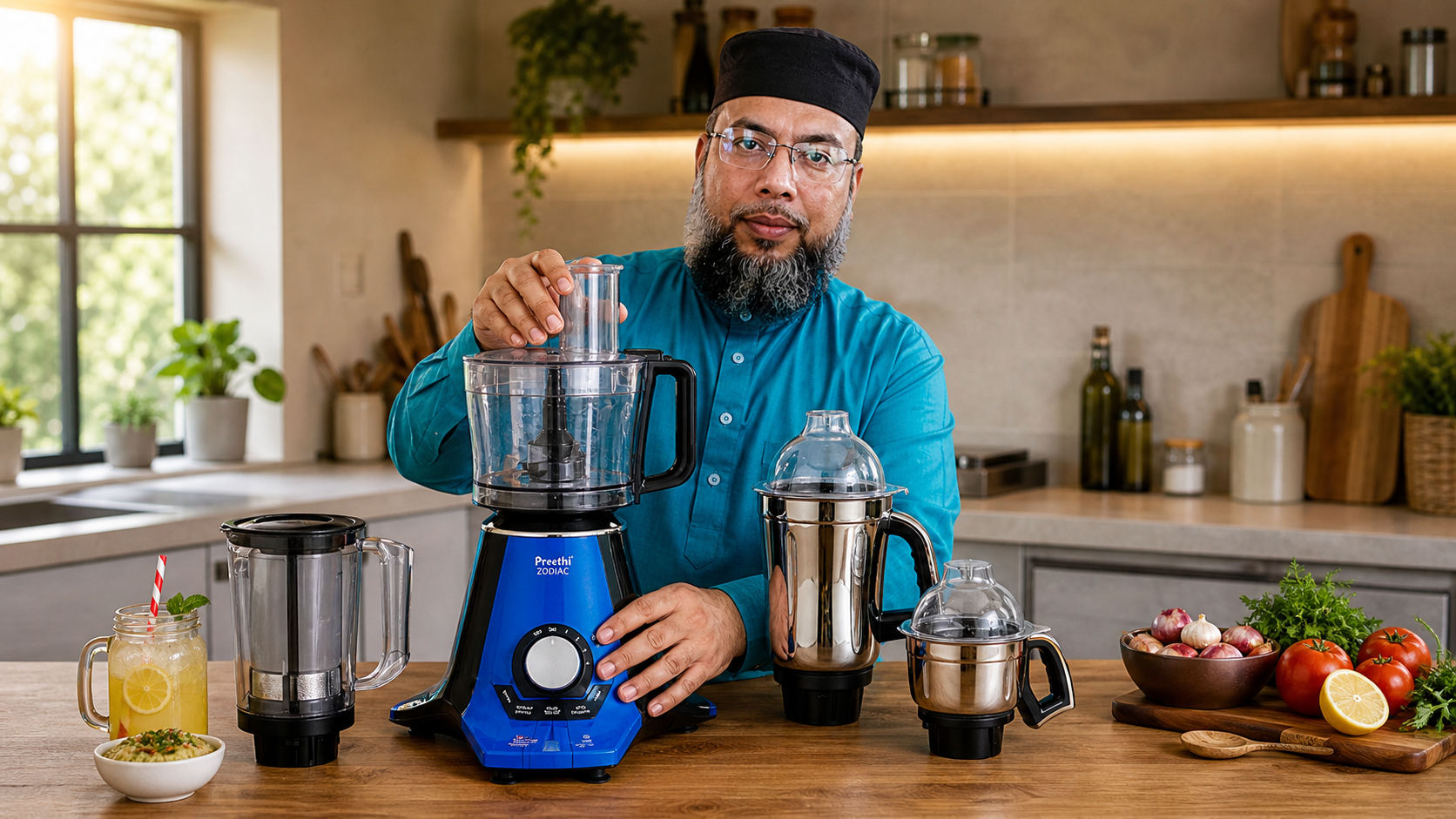
Indian cooking is fundamentally a grinding culture. Masala, chutney, batter, paste — these are the daily tasks that define Indian cuisine, and they all require the mixer grinder's impact force mechanism. A 750W mixer grinder (Preethi Zodiac, Bosch TrueMixx Bold) handles 90% of Indian cooking tasks perfectly. A 900W machine (Sujata Dynamix) handles the remaining 10% (large-batch batter, hard turmeric). A blender is a nice-to-have, not a need-to-have.
For Fitness Enthusiasts
Add a 400W Personal Blender
If you regularly make green smoothies, protein shakes, or frozen fruit blends, a personal blender is a worthwhile secondary appliance. Keep your mixer grinder for all Indian cooking tasks — add a compact personal blender (NutriBullet Pro 900, Philips HR2157) for your fitness drinks. The two appliances complement each other perfectly and together cover 100% of kitchen tasks.