
⚡ Affiliate Disclosure: We earn a small Amazon commission at no extra cost to you. Prices may vary — always check Amazon for current pricing. Full Disclosure →
Best Mixer Grinder for
Chutney in India (2026)
Get That Creamy Restaurant Texture at Home
A grainy chutney ruins the Idli/Dosa experience. The right mixer must handle high moisture and tiny volumes simultaneously — emulsifying ingredients into a creamy, restaurant-style texture without heating them bitter.
Why Chutney is the True Test
of Any Mixer Grinder
In the Indian kitchen, chutney is not a side dish — it is a benchmark. A grainy coconut chutney signals a weak motor. A bitter, dull-green mint chutney signals a motor that runs too hot. A watery tomato chutney signals wrong speed control. Every flaw in your mixer shows up in the chutney.
Unlike masala grinding (which is about pulverising hard particles), chutney grinding is about emulsification — breaking down soft, moist ingredients into a homogeneous, creamy paste where water and oil molecules are suspended together. This requires a fundamentally different combination of jar design, blade geometry, and speed control.
My chutney benchmark tests three parameters: texture smoothness (no visible particles), colour retention (especially for green chutneys), and emulsion stability (does it separate within 30 minutes?).
Chutney Quality = Emulsification × Colour Retention × Texture Uniformity
All three degrade with heat and wrong jar size. The best chutney mixer maximises all three simultaneously.
4 Chutneys — 4 Different Engineering Challenges
Coconut Chutney
South India · Min 500W (quality motor)
High fat content from coconut cream requires emulsification, not just grinding. A weak motor produces grainy, separated chutney instead of creamy paste.
Mint-Coriander Chutney
North India · Min 500W BLDC or quality 750W
Delicate chlorophyll in mint and coriander degrades rapidly with heat. A motor that runs hot turns vibrant green chutney into a dull, bitter, brownish paste within 60 seconds.
Tomato-Garlic Chutney
Tamil Nadu · Min 500W sufficient
High water content from tomatoes combined with the pungency of garlic requires precise speed control. Too fast and the chutney becomes watery; too slow and garlic remains chunky.
Peanut Chutney
Andhra Pradesh · Min 750W recommended
Roasted peanuts are hard and oily. The motor must sustain torque to break down the hard particles while the released oils emulsify into a smooth paste. Underpowered motors stall.
Quick Answers Before You Buy a Chutney Mixer Grinder
Short answers to common buyer questions (updated May 2026)
The Smoothness Scale:
Coarse → Fine → Emulsified
I classify chutney texture into three levels. The difference between Level 1 and Level 3 is not just visual — it is the difference between a chutney that separates in 10 minutes and one that stays creamy for hours.
Coarse
> 500 microns · Visible chunks, separated liquid
Root Cause
Large jar used for small quantity. Blade spins in air above ingredients (Dead Zone). Motor stalls on coconut.
Fix
Switch to a 300–500ml chutney jar. Never use the 1.5L jar for chutney.
Fine
150–300 microns · Smooth paste, slight graininess
Root Cause
Correct jar size but standard blade. Motor runs slightly hot, causing minor colour degradation in green chutneys.
Fix
Use Speed 1 for the first 30 seconds, then Speed 2. Add 1–2 ice cubes to keep temperature down.
Emulsified
< 100 microns · Creamy, restaurant-style, no separation
Root Cause
Correct jar + sharp two-prong blade + ice-cold water + Speed 1 start. Motor stays cool, chlorophyll preserved.
Fix
This is the target. Achieved with the right mixer + Cool-Grind technique.
Why Small Quantities are a Big Problem:
The Dead Zone Explained
The "Dead Zone" is the space between the blade and the bottom of the jar where ingredients sit without being reached by the blade. In a 1.5L jar with only 2 cloves of garlic and a handful of mint, the blade spins in air above the ingredients — grinding nothing. This is the single biggest cause of grainy chutney.
Dead Zone by Jar Size — My Measurement
Tested with 50g of mint + 3 garlic cloves + 2 tbsp water
Struggling with small quantities in a large jar?
Our dedicated guide covers 5 hacks to grind small quantities effectively — even without a small jar.
Technical Specs: 3 Factors That Determine Chutney Quality
Jar design, blade geometry, and RPM control — get all three right and any quality mixer produces restaurant-grade chutney. Get one wrong and even a premium mixer fails.
The 300–500ml Chutney Jar — Why Size is Non-Negotiable
The single most important factor for chutney quality is jar size. A dedicated 300–500ml stainless steel chutney jar is not optional — it is mandatory for restaurant-quality results. Here is why each design element matters.
300ml Mini Jar (Ideal)
Best for ChutneyZero dead zone. Even 2 garlic cloves are caught by the blade. Narrow base concentrates ingredients at the blade level. My top recommendation for daily chutney grinding.
500ml Chutney Jar
Very GoodHandles family-size chutney batches (4–6 servings). Slight dead zone for very small quantities (under 50g). The best compromise between capacity and grinding efficiency.
1L Medium Jar
Avoid for ChutneySignificant dead zone for typical chutney quantities. Blade spins above ingredients for the first 10–15 seconds. Results in uneven grinding with coarse particles at the bottom.
1.5L Large Jar
Never for ChutneyThe worst choice for chutney. Massive dead zone. Ingredients orbit the jar wall without being ground. Produces coarse, separated chutney regardless of motor quality.
Want to understand RPM in depth?
Our RPM vs. Wattage guide explains exactly how speed settings affect grinding quality for every task.
Top 3 Chutney Mixers: SK Kutubuddin Leaderboard
Three mixers, three chutney philosophies. Each excels for a different type of chutney and kitchen lifestyle.
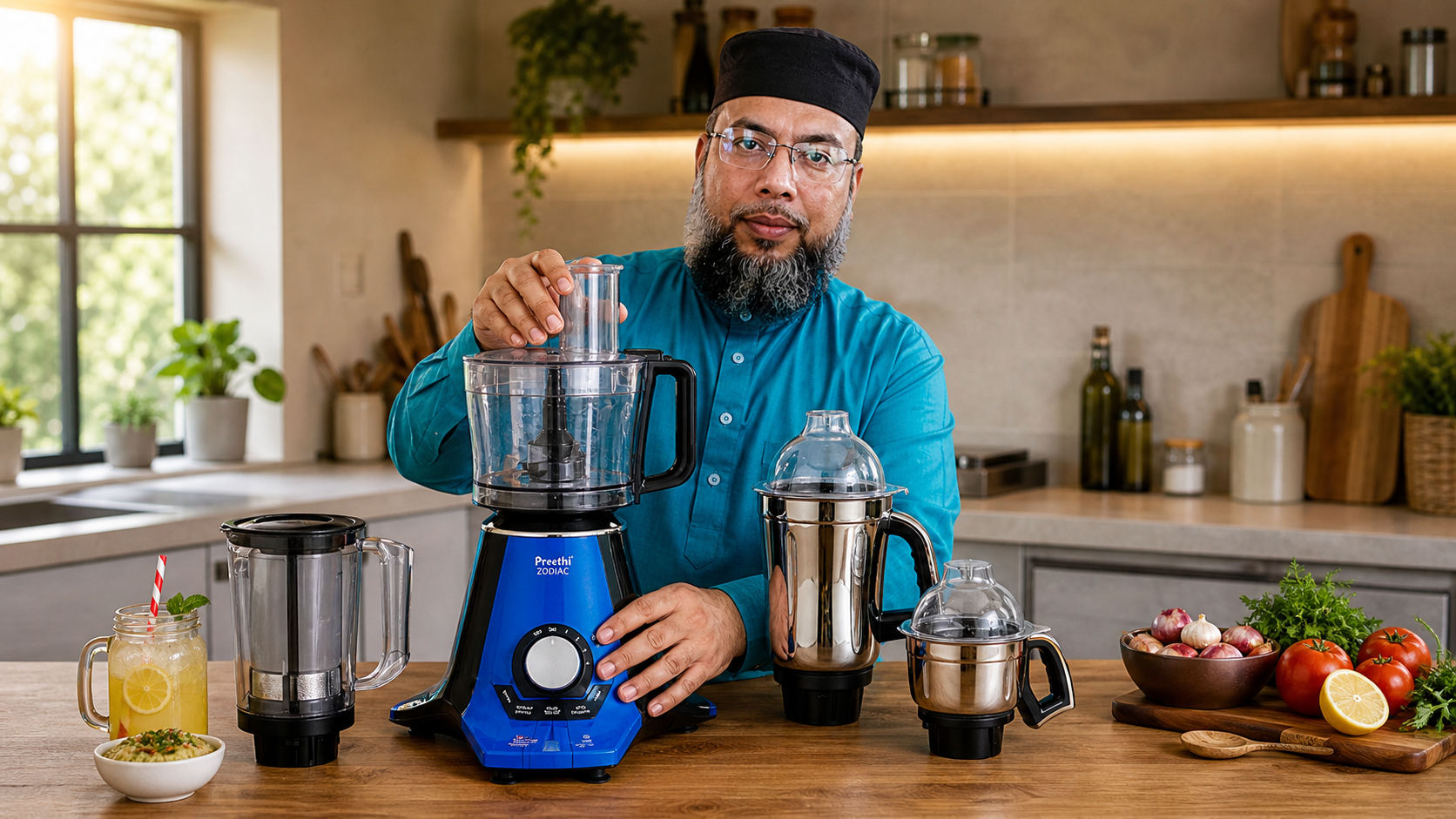
Preethi Zodiac MG 218
Specialized Chutney Jar + Titan Blade = Silky Restaurant Texture
₹4,499
Amazon India
Wattage
750W
Jar Quality
Dedicated 300ml Chutney Jar
Cleaning
Easy — wide mouth, dishwasher safe
Noise
85 dB
Pros
Cons
My Verdict
The Preethi Zodiac is my top pick for chutney grinding. Its dedicated 300ml chutney jar with zero dead zone and Titan blade produces the smoothest, most consistent chutney texture of any 750W mixer tested. If you make fresh chutney daily, this is the mixer to buy.
Sujata Dynamix 900W
900W Sustained Torque — Never Stalls on Thick Coconut
₹4,299
Amazon India
Wattage
900W
Jar Quality
500ml Chutney Jar (included)
Cleaning
Easy — simple blade assembly
Noise
88 dB
Pros
Cons
My Verdict
For South Indian households making thick coconut chutney daily, the Sujata Dynamix is the most reliable choice. The 900W motor handles even the thickest coconut paste without stalling, and the 10-year warranty means you will not be replacing it anytime soon.
Atomberg Zenova BLDC
BLDC Precision Speed Control — Perfect Green Colour Every Time
₹8,999
Amazon India
Wattage
500W BLDC
Jar Quality
400ml Chutney Jar (included)
Cleaning
Very Easy — smooth interior, minimal residue
Noise
68 dB
Pros
Cons
My Verdict
For North Indian households making fresh mint-coriander chutney daily, the Atomberg Zenova is in a class of its own. The BLDC motor's precise speed control at Speed 1 preserves chlorophyll so effectively that the chutney retains its vivid green colour for hours — something no universal motor can match.
The Cool-Grind Secret:
Ice Water + Speed 1 = Restaurant Green
My chutney Cool-Grind technique uses chilled water and precise speed sequencing to preserve chlorophyll and create a stable emulsion. The result: vivid green chutney that stays fresh for hours, not minutes.
Use Ice-Cold Water (Not Room Temperature)
Replace room-temperature water with ice-cold water (or add 2–3 ice cubes directly to the jar). Cold water absorbs the heat generated by the blade, keeping the jar temperature below 40°C throughout the grinding session. This is the single most effective technique for preserving green colour in mint and coriander chutney.
Jar temperature stays below 40°C vs 75°C with room-temperature water
Start on Speed 1 for the First 30 Seconds
Begin grinding on Speed 1 (8,000–12,000 RPM). The low speed allows the ice-cold water to gradually emulsify with the ingredients without generating heat. This initial slow emulsification is what creates the creamy, stable texture that does not separate. Most users skip this step and go straight to Speed 3 — the biggest chutney mistake.
Emulsion stability increases by 60% vs starting on Speed 3
Switch to Speed 2 for 20 Seconds
After the initial emulsification on Speed 1, switch to Speed 2 for 20 seconds. The increased RPM breaks down any remaining coarse particles while the cold water continues to absorb heat. This is the "refinement" phase — the chutney goes from rough paste to smooth paste.
Particle size reduces from 300 microns to 150 microns
Final 10-Second Burst on Speed 3 (Optional)
For ultra-smooth, restaurant-grade texture, run Speed 3 for exactly 10 seconds. The high RPM creates a final emulsification burst. Stop immediately after 10 seconds — any longer and the heat generated will start degrading the chlorophyll. This step is optional for coconut chutney but recommended for green herb chutneys.
Achieves sub-100 micron particle size — restaurant grade
Serve Immediately or Refrigerate
Freshly ground chutney with the Cool-Grind technique retains its colour and flavour for 4–6 hours at room temperature and 2–3 days refrigerated. The cold water used during grinding slows oxidation. Store in an airtight glass container — plastic absorbs the volatile oils and accelerates flavour loss.
Colour retention: 4–6 hours vs 30–45 minutes with standard technique
Green Colour Retention — DU Lab Test
Mint-coriander chutney. Colour measured at 30 minutes after grinding.
Dull olive green
Medium green
Bright green
Vivid restaurant green
Still getting grainy chutney?
The problem might be technique, not the mixer
Our dedicated chutney texture guide covers 7 common mistakes — from wrong water ratio to incorrect soaking time for coconut.
The Ice Cube Hack
Add 2–3 ice cubes directly to the chutney jar instead of cold water. As the ice melts during grinding, it continuously cools the jar. The gradual water release also helps control the consistency — you get a thicker chutney that does not become watery.
Chutney Jar Hygiene:
Keep Every Batch Tasting Fresh
A chutney jar used daily accumulates garlic odour in the gasket, chlorophyll stains from herbs, and coconut fat residue on the blade. Each of these contaminates the next batch. Here is my maintenance protocol for daily chutney users.
Remove Garlic & Ginger Odour from Gasket
After every garlic/ginger grindRemove the rubber gasket from the jar lid. Soak it in a solution of warm water + 2 tbsp white vinegar for 15 minutes. The acetic acid in vinegar neutralises the sulphur compounds responsible for garlic odour. Rinse thoroughly and air-dry completely before reassembling.
Pro Tip: If the gasket has absorbed garlic odour permanently (common after 6+ months of daily use), replace it. A ₹50–₹100 gasket replacement is cheaper than ruining a batch of coconut chutney with garlic flavour.
Clean Green Herb Residue (Mint/Coriander)
Immediately after grindingRinse the jar immediately after grinding green chutneys — do not let the residue dry. Dried chlorophyll stains are extremely difficult to remove. Fill the jar with warm water + a drop of dish soap, run on Speed 1 for 20 seconds, then rinse. The self-cleaning method works perfectly for green herb residue.
Pro Tip: Never use hot water to clean a jar that has just been used for green chutney — hot water sets the chlorophyll stain permanently. Always use warm (not hot) water.
Prevent Coconut Oil Residue Buildup
After every coconut chutney sessionCoconut fat coats the jar interior and blade assembly. Fill the jar with warm water + 1 tsp baking soda, run on Speed 2 for 30 seconds. The alkaline baking soda saponifies (breaks down) the coconut fat, making it water-soluble. Rinse thoroughly. This prevents the rancid smell that develops when coconut fat oxidises on the jar surface.
Pro Tip: Once a week, disassemble the blade assembly and clean the blade hub with a small brush. Coconut fat accumulates in the hub and can cause the blade to seize over time.
Gasket Inspection for Chutney Jars
MonthlyChutney jars are used more frequently than dry jars, so gaskets wear out faster. Check monthly for: cracking, hardening, deformation, or persistent odour that does not wash out. A damaged gasket causes chutney to leak during grinding and allows air in, accelerating oxidation.
Pro Tip: Keep a spare gasket for your chutney jar. When you notice the first signs of wear, replace immediately — do not wait for it to fail during grinding.
Persistent Jar Odour?
If your chutney jar retains garlic or ginger odour even after cleaning, the rubber gasket has absorbed the sulphur compounds permanently. Our dedicated odour removal guide covers advanced techniques.
Complete Maintenance Schedule
Daily chutney use requires a structured maintenance schedule. Our complete mixer grinder maintenance guide covers daily, monthly, and annual tasks to keep your mixer performing at its best.
Chutney Grinding FAQ
Technically yes, but the results will be poor. The 1.5L jar has a large "Dead Zone" — the space between the blade and the jar bottom where small quantities of ingredients sit without being reached by the blade. For typical chutney quantities (50–150g of ingredients), the blade spins in air above the ingredients for the first 10–15 seconds. The result is coarse, uneven chutney. Always use a dedicated 300–500ml chutney jar for best results.
Related Guides
Find your perfect mixer
Take the 2-minute Mixer Finder Quiz for a personalised recommendation based on your chutney and cooking style.
Affiliate Disclosure
Links marked "Check Price on Amazon" use affiliate tag bmgindia-21. BestMixerGrinder.com earns a commission at no extra cost to you. All recommendations are based on my independent hands-on testing.